COMMUNITY
-
Fire culture is a set of shared knowledge, values, and practices communities develop because of fire, either for a specific goal, within a specific landscape, or because of an occupation. It reflects how people understand fire’s power to both heal and harm, use it with purpose, respect its force, and pass that knowledge across generations. Returning fire culture can mean reconnecting with fire as a natural force and essential tool, bridging experiential gaps of understanding, honoring fire’s power, remembering fire’s origins, and adapting to live with it in ways that shape a more resilient future for everyone.
-
Using a community organizing model to form prescribed burn associations and programs helps move people from interest to action, and from curiosity and fear to understanding and resiliency. By using a structured process from an understanding of the larger picture, a prescribed burn association (PBA) advocates for positive changed behavior toward the topic of using fire as a community-accepted practice. By building relationships with landowners, contract burners, agencies, foresters, mentors, scientists, students, schools and the public, a PBA connects people in a skillful manner making prescribed fire safe, practical, understandable, doable, and enjoyable. Living in fire-adapted ecosystems can feel unsettling, but prescribed burn associations build the trust, coordination, education, and shared stewardship communities need to use prescribed fire safely and effectively. In essence, the coordinator and or leader of a burn association plays a key role to strategically engage everyone interested in getting more fire on the ground while creating an inclusive process to shift our relationship from fire suppression to an ecological norm that we live with.
Since 2023, there has been a prescribed burn association and cultural burn association renaissance. The number of associations across the United States has increased significantly. Instead of waiting for state or federal programs or agencies to manage overgrown vegetation, private landowners and others have become organized and are taking advantage of the benefits of grassroots efforts. By private landowners and communities taking charge, they can fill the gaps and drastically improve the landscapes we call home. In all honesty, state and federal agencies could never burn it all on their own and it has to be a collaborative effort.
-
Barn raising was once a common form of mutual aid in rural America: neighbors gathered to build or repair farm and community structures without direct payment because the work strengthened everyone in relationships. Prescribed burn associations carry forward that same ethic. By knowing one another, communicating before burns, and pooling labor, equipment, local knowledge, and experience, neighbors can conduct safer prescribed fires across property lines. This shared work reduces hazardous fuels, improves land health, lowers wildfire risk, and helps experienced burners mentor the next generation. In a time when people are often separated by busy lives and property boundaries, prescribed fire reminds communities that good land stewardship depends on trust, cooperation, and reciprocity. Neighbor-helping-neighbor is the tagline often highlighted when talking about prescribed burn associations and it's there for a good reason. Learning new ways of how to communicate and connect with neighbors can sometimes be a challenge. With a little smile and more time spent outside, a greeting and an invite or an offering to help can go a long way in making a connection.
-
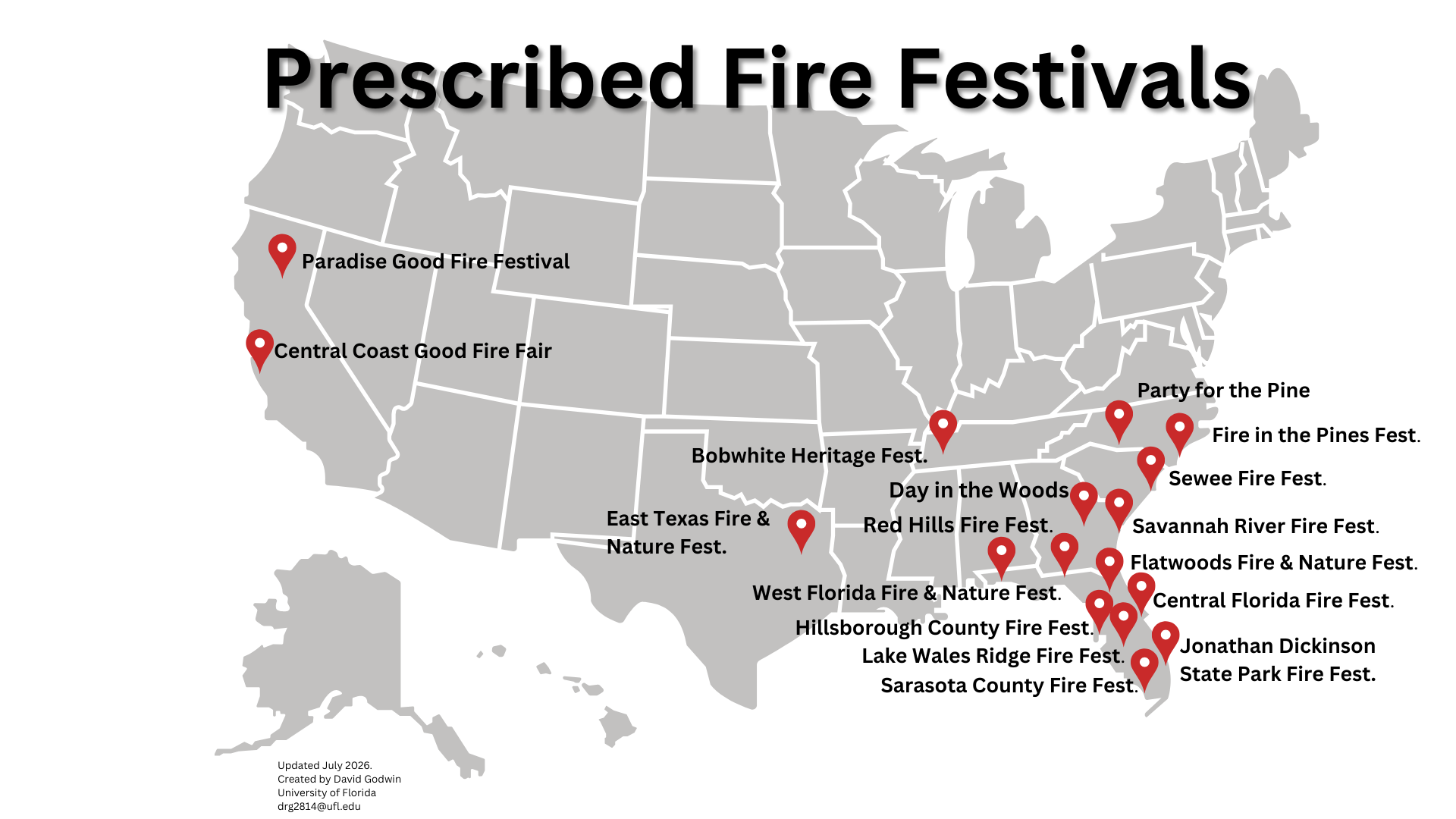
Party for the Pine (Southern Pines, NC). A free annual celebration for the oldest known Longleaf Pine in the world, estimated to have sprouted in 1548. Hosted by Weymouth Woods Sandhills Nature Preserve and Friends of Weymouth Woods, this iconic fire festival is seated in the heart of the Sandhills of NC, and engages the community by bringing conservation partners together to educate in a family-fun way about prescribed fire.
Fire in the Pines (Wilmington, NC). An annual and free Fire Festival in the fall, usually in the beginning of October that engages the Coastal Plain communities of NC on the benefits of prescribed fire for ecosystem health, highlighting rare species like the venus fly trap, and having local conservation partners available all in one place for questions and information.
Harris Lake County Park Events (New Hill, NC),
Harris Lake County Park (address: 2112 County Park Dr, New Hill, NC 27562), managed by Wake County puts on a longleaf celebration called the Longleaf Ramble in the fall once a year. This is a free event that focuses on all things prescribed fire and showcases their sixty acres of managed Longleaf Pine forest. Their longleaf restoration project started in 1997 by a company called “Forestry Management” based out of Rocky Mount, who planted the longleaf. On this site there were already a few remaining mature Longleaf Pine trees that gave additional importance to reestablish this once abundant tree in NC. If you'd like to learn more about Harris Lake’s historic and natural significance, click here.Bladen Lakes Area Fire Festival (Elizabethtown, NC) TBD. This Fire Festival is currently in the planning stages and is scheduled to take place September 25, 2027 at Jones Lake State Park in Elizabethtown, NC. The focus of the festival is to educate the larger public, families, and private landowners about Carolina Bays and Prescribed Fire topics, how they intersect, and why they are important as historical and cultural markers of the Bladen Lakes Area region.
More Fire Festival Information
If you are interested in starting a Fire Festival in your area, a great place to start is by visiting the NCSU's Southeast Fire Update "Fire Festival" page. You can also send a message with your questions through the Contact Us tab or Contact Us with questions. -
Firewise USA® helps neighborhoods reduce wildfire risk through home hardening, defensible space, fuel reduction, and community planning. Firewise communities are neighborhoods recognized for taking ongoing wildfire-preparedness actions. Together, Firewise communities and Prescribed Burn Associations can strengthen local wildfire resilience from the home outward to the surrounding landscape.
How to get involved: To become recognized, a community organizes a resident committee, works with a local wildfire expert on a community wildfire risk assessment, creates a multi-year action plan, completes annual wildfire-risk reduction work, and reports those activities each year through the Firewise USA® portal. In NC, the Piedmont PBA and Southern Blue Ridge PBA are the most active in helping communities become Firewise.